
Wednesday One Thing - DANGER! Microwave Oven In Use!
Wednesday One Thing - DANGER! Microwave Oven In Use!

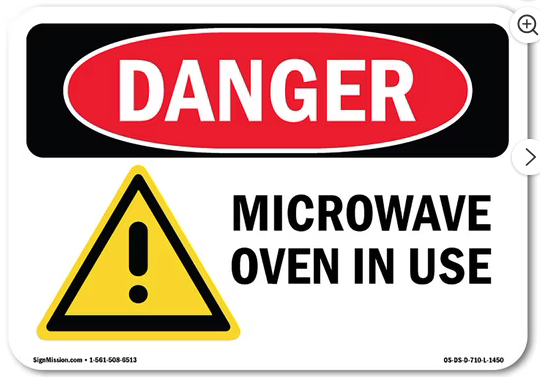
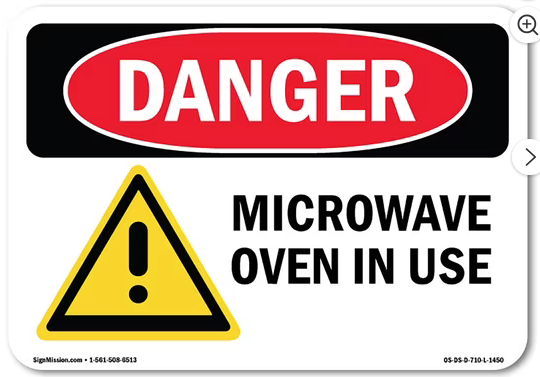
I'm 61. I remember when the scariest thing in a restaurant wasn't the bill. It was a little sign by the kitchen door.
Danger: Microwave Oven in Use
I'd have sworn under oath that Michigan made every restaurant post a sign saying DANGER: MICROWAVE OVEN IN USE. Turns out no law required it. Restaurants put those signs up anyway, which tells you how scared everybody was. You probably remember them: "Persons wearing pacemakers do not enter." Nothing makes you want a hot sandwich like a sign suggesting the kitchen might stop your heart.
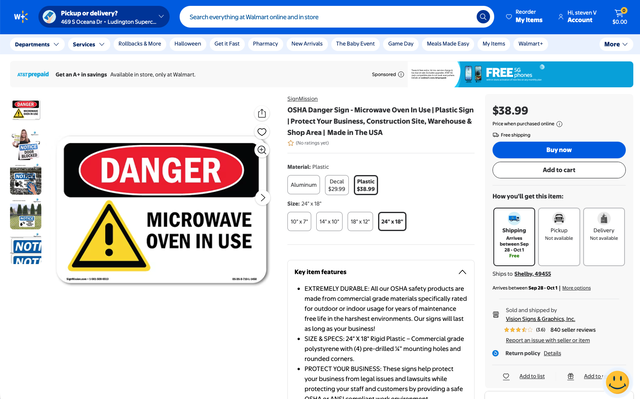
And here's the best part. You can still buy one. Walmart will sell you a brand-new "OSHA DANGER: Microwave Oven In Use" sign today, in 2026. The listing says it will "Protect Your Business," and it's made in the USA. It's recommended for your construction site, warehouse, or shop, in case the Hot Pocket in the break room gets any ideas. Nearly 60 years after microwaves reached home kitchens, the panic is still in stock. Just click on the Walmart image below and Walton Goggins will deliver it to your door in just minutes.
Here's what the country was afraid of back then:
- Going blind from watching your popcorn through the little window. People really believed this. Grandma stood across the room, which is exactly where a person should be while food is spinning under death rays.
- Sterility, cataracts, and cancer. A 1978 magazine investigation was titled, and I'm not making this up, "Cooking with Your Fingers Crossed."
- Radioactive leftovers. Tuesday's meatloaf, now glowing.
- The Russians. The Soviets allowed far less microwave exposure than we did, and they really were beaming microwaves at our embassy in Moscow. So obviously the Amana on your counter was a Cold War weapon.
In March 1973, Consumers Union, the people behind Consumer Reports, issued a warning against buying microwave ovens at all. That was the most trusted shopping advice in America, telling you to put down the Radarange and walk away.
It was never about the coffee!
Notice something about that list. Nobody was very worried about what the microwave did to the coffee. The coffee got hot. That was the point.
The fear was about what got out of the box.
Radiation slipping through the door seal, past the window, across the kitchen, and into you, your eyes, your pacemaker, your future grandchildren. Inside the box it was a kitchen appliance. Outside the box it was the Cold War.
And some of that fear was earned. Early ovens did leak. A government study found a worrying share of them over the limit, and GE had to recall some models. Early pacemakers really could be thrown off. The fear wasn't stupid. It just had nowhere to go yet.
So what happened? Nobody banned the microwave. We built a better box. The government set a leak limit measured two inches outside the oven. Manufacturers added door switches that shut everything off the moment you open it. That little window got a metal mesh screen with holes too small for microwaves to pass through. So you can watch your burrito explode without the rays getting out. Pacemakers got shielding. By 1977, a newspaper buying guide was reporting there was "no evidence that anyone has ever been injured by radiation from a microwave oven."
About a quarter of American homes had one by 1986, and 90% did by 1997. Today the FDA politely notes that microwaves "do not make food radioactive," which is the kind of sentence you only have to write after an entire nation has panicked.
Now swap "microwave" for "AI"
It's going to make us stupid. It's going to take our jobs. It's secretly watching us. It's a foreign weapon. Nobody really knows how it works, so it must be dangerous.
But listen to how people actually talk about it. Most folks aren't scared of AI writing a birthday poem or summarizing a meeting. That's the coffee. The fear is AI getting out of its box: acting on its own, going rogue, doing things outside the chat window that nobody asked for and nobody can shut off. The people who work on this for a living even call it "keeping AI in the box."
Sound familiar? It's the same fear, 50 years later. Nobody fears the box. People fear the leak.
Who's selling the sign?
Remember, no law ever required those microwave signs. Somebody still printed them, somebody sold them, and 50 years later somebody is still selling them. Fear has always been good business.
So when the AI fear gets this loud, ask the oldest question in the book: who profits?
- Fear gets clicks. "AI might end humanity" gets more clicks than "AI helped a dentist with his scheduling." Guess which headline you've seen more.
- Follow the campaign money. The AI industry is pouring tens of millions of dollars into this year's elections, split into two camps. One is backed by an AI company that wants more rules. The bigger one is backed by investors and executives who want fewer. Here's the kicker: most of their ads don't mention AI at all. Makes you wonder what they're really buying.
- The companies building it are the ones warning you about it. Think about how strange that is. Imagine Amana's CEO on the evening news in 1975 saying, "Our product might cook your family. Please regulate us." That's roughly what's happening. This month, the heads of the biggest AI labs publicly agreed the industry should slow down under government-coordinated standards. Critics had a name for it right away: regulatory capture. That's when you help write the rules for your own industry, and somehow they fit you perfectly and crush the startup in the garage.
- And here's the question nobody's asking out loud. Right now, if an AI does something harmful, the company that built it owns the mess. But if the government writes the rules and the company follows them, who owns the mess then?
That isn't a paranoid question. One California bill proposed giving AI companies that get certified a built-in defense in lawsuits over injuries or property damage. In plain English: follow the rulebook, and "we were certified" becomes your shield. Remember that microwave leak limit? Stay under it, and your oven was officially "safe." A rulebook protects the public. It can also protect whoever wrote it.
I'm not telling you the fear is fake. Some of it is earned, just like those leaky early ovens. I'm telling you to check who printed the sign before you hang it on your door.
Build the box, then check the box
The microwave story didn't end with smashing the oven, and it didn't end with pretending the door seal was perfect. We measured what escaped. We built switches that shut it off. We put up screens that let us see inside without letting the dangerous part out. We kept checking the seals for as long as the thing was plugged in.
New and not yet understood doesn't mean evil. It means we haven't built the box yet, or tested it enough to trust it. And it means we should be very curious about who's selling the box, who's selling the fear, and who's writing the rules.
So do the homework. And in about 20 years, when your grandkids find a "DANGER: AI IN USE" sign in a Walmart clearance bin, you can tell them you were there when people were afraid of it. Then tell them who got rich selling the sign.
Sources:
- The 1973 Consumers Union warning (NYT headline, cited on Wikipedia)
- The 1978 "Cooking with Your Fingers Crossed" investigation
- Newspaper buying guides from the 1970s, including the 1977 quote
- IEEE Spectrum: a history of the microwave oven
- Boston University on the early fears and the 1971 federal standard
- FDA: microwave ovens (door switches, leak limit, pacemakers, "not radioactive")
- The Moscow Signal (microwaves beamed at the U.S. embassy)
- J. J. Keller on the pacemaker signs and OSHA (no law required them)
- The Walmart sign, still for sale
- NBC News: AI industry ads flooding the 2026 election, mostly not about AI
- TechCrunch: AI lab leaders propose to "pace the frontier" (Sept. 12, 2026)
- The Register: "Big AI sets out its terms for regulatory capture"
- Pillsbury Law: California SB 813's proposed lawsuit defense for certified AI companies
- Cambridge study on the microwave safety debates of the 1970s and '80s
