
Wednesday One Thing - The Color of Confomity
Wednesday One Thing - The Color of Confomity


The Color of Conformity
Pull up to any stoplight in America and look around. White. Black. Gray. Gray. Black. White. Maybe a blue one, which feels so daring you want to roll down the window and ask if they're okay.
It didn't used to be like this.
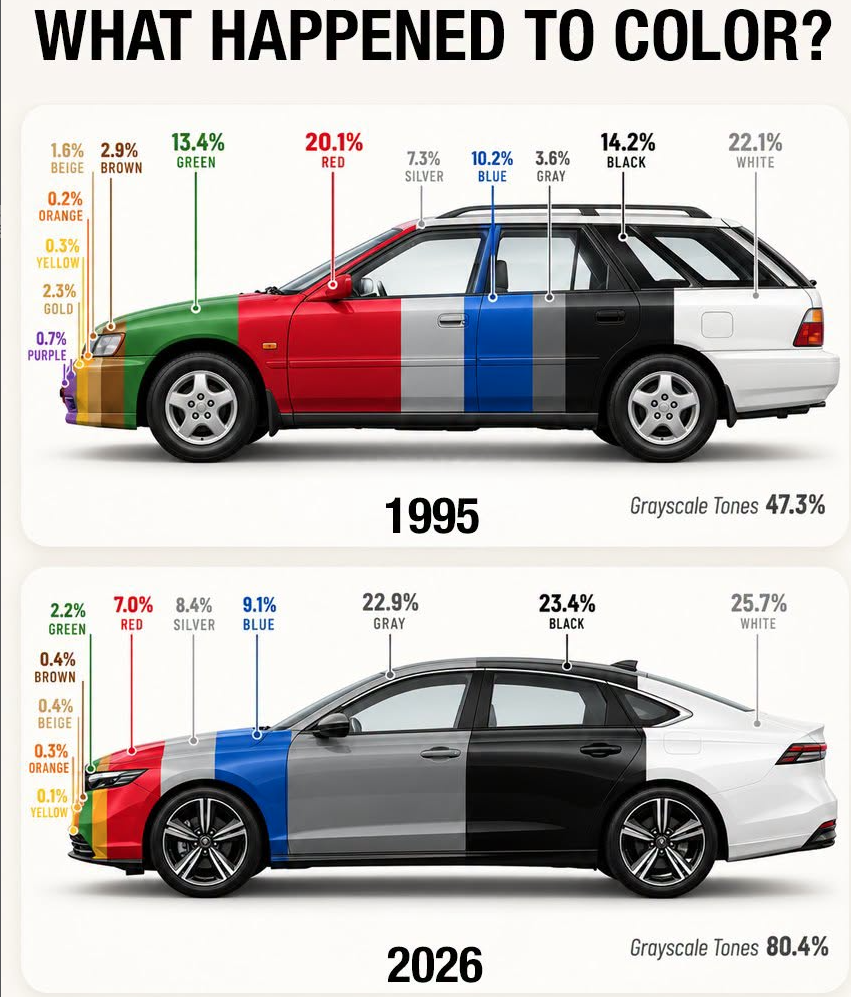
In the mid-'90s, car buyers actually chose colors, as in plural. Red was nearly as popular as white. Green outsold gray almost four to one. People drove gold cars. On purpose. Somebody bought a purple one and lived with that decision every single day.
Today? Gray went from 3.6% of new cars to 22.9%, a jump of 528.4%. Red fell to 7%. Green is a rounding error. White, black and gray now make up nearly three-quarters of everything sold, and once you add silver, about four out of every five new cars on the road have no color at all.
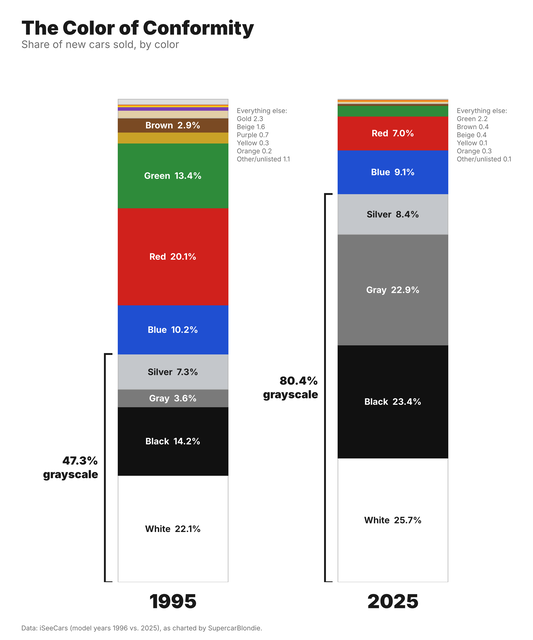
Here's the part that should bother you. The carmakers didn't take the colors away. The average model still comes in 6.7 colors, compared to 7.1 twenty years ago. The paint is right there on the order sheet. We're just not picking it.
And it's not just cars.
Look at the golf course. According to Titleist, 73% of PGA Tour players this season have teed up a Titleist ball. Fine, they're pros, they get paid. But walk your local course on a Saturday and count how many weekend hackers are swinging the exact same clubs, with the exact same ball, in the exact same quarter-zip, as if a 22 handicap is one equipment upgrade away from Augusta.
Look in your closet. Look at your neighbor's closet. Same jacket. Same sneakers. Same logo. Same "effortless" look that took everyone the same effort to copy.
This isn't just a vibe, either. Researchers studied over 7,000 photographs of objects in the Science Museum Group collection and found everyday things may have become a little greyer and a little squarer over time. Greyer and squarer. That's not a design trend. That's a description of all of us at the office.
There are roughly ten million colors the human eye can tell apart. Ten million. And we have collectively, as a society, agreed on three. Without a meeting. Without a vote. We just looked at what the person in front of us bought and said, "Yeah, that."
This week's one thing: The next time you buy something — a car, a jacket, a golf ball, a couch — ask yourself whether you are buying it because you actually want it, or whether you are buying it because you just don't want to stand out.
Then go buy the green one.
