
Wednesday One Thing - Twenty-Six Words That Ate the World
Wednesday One Thing - Twenty-Six Words That Ate the World

Twenty-Six Words That Ate the World
Here it is, the entire law. Hold onto something:
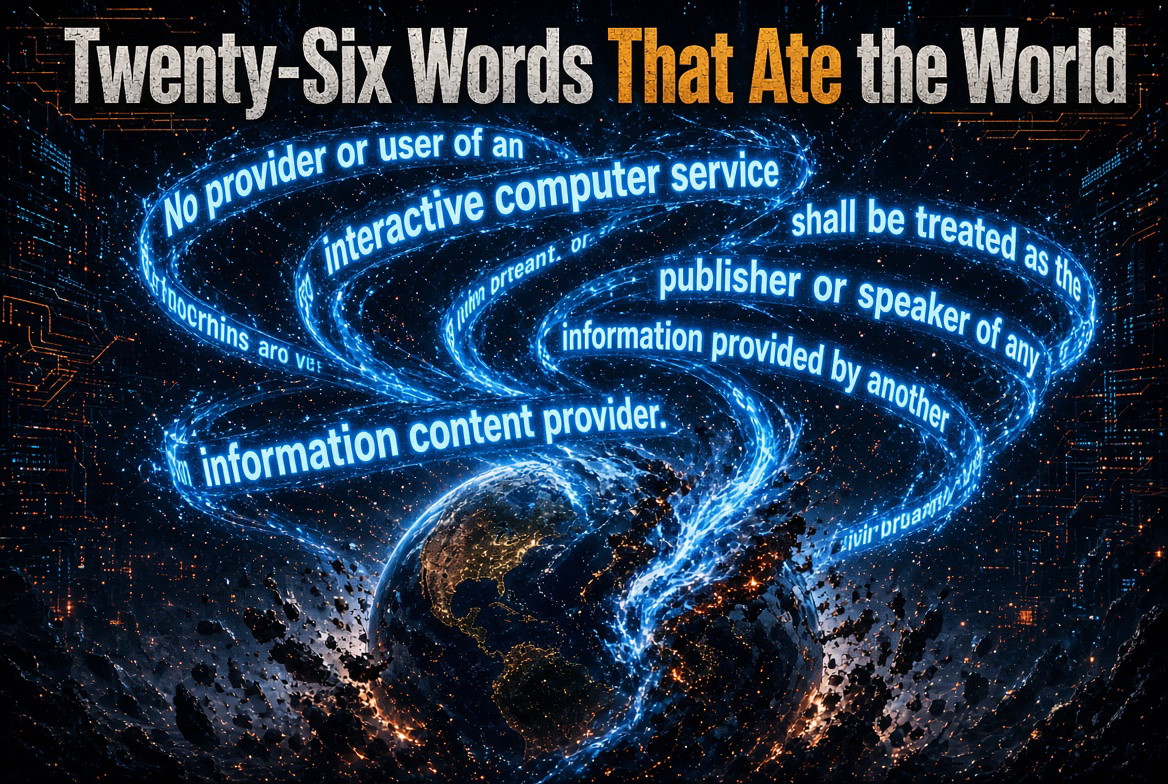
“No provider or user of an interactive computer service shall be treated as the publisher or speaker of any information provided by another information content provider.”
That’s it. Read it again if you like, it won’t take long. It’s shorter than a Waffle House order and shorter than the disclaimer on a 30-second car ad. It’s shorter than the email your HOA sent about trash can placement. These twenty-six words have done more to shape modern civilization than most constitutions, and they read like they were written by someone trying to hit a word count from the wrong direction.
A creation myth written by a raccoon
Section 230 arose in response to a 1995 ruling penalizing platforms for moderating content. In plain English, a website tried to keep its message boards clean, and a court said it was now on the hook for everything on them. The message to every future tech company was crystal clear: never pick up the trash, because picking up the trash means you own the landfill.
So Congress swooped in to fix it. But this wasn’t even what Congress was there for. As one law professor put it, “What they were thinking about was Section 223. They were worried about porn.” The courts tossed the porn part almost immediately, and the afterthought paragraph went on to run the planet. It’s like showing up to a yard sale for a lamp and leaving with the deed to the house, the neighbor’s house, and a controlling stake in the human attention span.
“We’re just a bulletin board,” says the bulletin board with a PhD in you
The 1996 theory was that platforms are like the corkboard at the laundromat. You don’t sue the corkboard because somebody pinned up a bad flyer.
Fine. Now picture a corkboard that follows you home and watches you sleep. It knows you’re lonely on Sundays, angry on Tuesdays, and willing to buy almost anything at 1:47 a.m. It has studied your thumb speed and worked out that a video of a stranger popping a pimple keeps you around nine seconds longer than a video of your own grandchild. It auctions off those nine seconds to the highest bidder, then serves up the next flyer before you’ve blinked, every time, forever.
Then it hires lawyers to explain to a judge, with a straight face, that it’s basically a corkboard. It’s the most profitable corkboard in history, and somehow it’s never responsible for a single thumbtack.
2026: The year the corkboard got subpoenaed
- March: A Los Angeles jury found Meta and YouTube negligent in the design or operation of their platforms. The lawyers pulled off the legal equivalent of finding the unlocked back door: they ignored the content entirely and went after features intended to hook young users, including notifications and autoplay features. The 26 words protect what’s on the corkboard. Nobody wrote a law protecting the slot machine bolted to the front of it, the one with the flashing lights and the little “ding” a child’s brain can’t resist. And this was the second verdict against Meta this week, after a jury in New Mexico determined the company harms children’s mental health and safety. That’s two juries in one week. Most of us can’t get two dentist appointments in one week.
- August: A federal appeals court clarified that Section 230 protects platforms from final liability, not from being hauled into court in the first place. The judges then admitted, in writing, that they had been using the word “immunity” “somewhat loosely” in earlier cases. They mean the word at the center of the most consequential internet law ever written, used “somewhat loosely” for thirty years. Imagine your surgeon saying they’d been using “left” and “right” somewhat loosely. Somewhere a trial lawyer just upgraded the boat to a slightly bigger boat with a smaller boat inside it.
- Congress (brace yourself): Just before Christmas 2025, a bipartisan coalition of U.S. senators... introduced legislation to sunset Section 230 of the Communications Decency Act on January 1, 2027. The strategy was to set a hard deadline so Congress would be forced to finally do its job. It’s the legislative version of hiding your own car keys so you’ll be forced to walk to the gym. Current status: Introduced on Dec. 17, 2025. The deadline is six weeks away, and the bill hasn’t moved an inch. Congress built itself a ticking time bomb as motivation and then went to lunch. For eleven months. The bomb is fine, thanks for asking, and it’s still ticking. Congress is still at lunch.
The great American unity project
Both sides say it needs work, but they don’t agree on why. One half of the country says the platforms delete too much and the other half says they don’t delete enough. Everyone is furious, and everyone is furious in the opposite direction. It’s the only issue in America where everyone agrees the referee is blind and nobody can agree which team he’s helping. Congress has looked at all of this and responded with the urgency of a sloth on a muscle relaxer.
But before you light the torches...
The trillion-dollar companies will survive just about anything you do to this law. They employ more lawyers than some countries have citizens. The ones who’ll get flattened are the little guys. The new rulings already mean online services that host user speech, especially smaller ones, may have to endure discovery, summary judgment, or trial before they can benefit from Section 230. That means the volunteer running your town’s Facebook group, the retired guy with the fly-fishing forum, and every small business with a comment box and a dream. Swing at the giants carelessly and you’ll miss them by a mile and hit everyone hiding behind them. The giants will then buy whatever’s left over. They’ll send flowers.
The One Thing
The 26 words never said platforms were innocent. They said only that the platform isn’t the one talking. But a machine that decides what you see, when you see it, how long you’ll keep seeing it, and what it can charge someone else for the privilege isn’t standing quietly on the laundromat wall. It’s been talking the whole time. It just had a really good lawyer and twenty-six words of plausible deniability.
Twenty-six words got us into this, and it’s going to take a lot more than twenty-six to get us out. Don’t worry, though. Congress has a deadline.
